

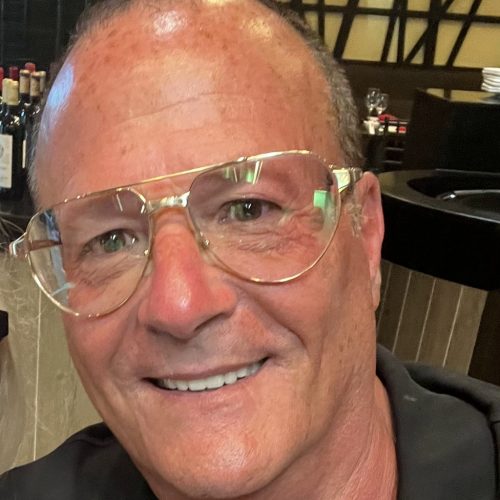
Ron Yas rolls down the JGH corridor on Tuesdays with a simple policy: everyone gets ice cream. If a patient says no, the ice cream goes to the family member sitting at the bedside.
“There’s no negativity in my life,” he says. “It’s only positive. And I want to make people feel positive.”
Ron has been a Hope & Cope volunteer since January 2026. On Tuesdays, he covers both the palliative care unit and the K7 oncology ward at the Jewish General Hospital. He is warm, funny, and relentless in his optimism. He is also a double amputee who uses a wheelchair. He will be the first person to tell you that none of that is the point.
In his 50th year, Ron was diagnosed with Buerger’s disease, a rare vascular condition affecting roughly one in a million people that causes the arteries in the outer extremities to deteriorate and disappear. He spent close to a year at the Royal Victoria Hospital undergoing seven surgeries. Both legs were amputated below the knee.
Years later, a complication led to a third major surgery: an above-the-knee amputation on his left leg. Standing in the operating room beforehand, Ron looked at his surgeon and said, “That’s the last body part you’re getting.”
He has walked and rolled with that spirit ever since.
A Debt He Wanted to Repay
His connection to palliative care runs deep. About ten years ago, his mother was diagnosed with stage four colon cancer and transferred to palliative care within days. She passed away shortly after, with Ron at her side.
Six years later, his father was brought to palliative care following a heart attack and a fall that caused a brain bleed. Ron slept at the hospital every night. His father passed in the early morning hours, just after Ron had been sent home to rest.
What stayed with him from both losses was not only the grief, but the quality of care.
“They were so nice to me in palliative care when I was there with my mother and my father,” he says. “I wanted to give back.”

So he reached out to Rifka, Hope & Cope’s palliative care and bereavement program coordinator. There were no openings right away, and a spot in the emergency department did not fit his schedule. Then, in January 2026, Rifka called. Ron said he could start any Tuesday. She told him to come the following week.
“I was nervous at first,” he admits. “I really didn’t know what to expect.”
The nerves lasted until he met his first patient.
Two Floors With Different Approaches
Ron now splits his Tuesday mornings between two distinct environments, and he approaches each one differently.
On K7, the oncology ward, patients are there for treatment. Many are frustrated, anxious, and looking for someone to talk to. Ron describes his role there as something close to a punching bag. He means it without complaint.
“They want to talk a lot more,” he explains. “They’re upset about treatments, about the nurses, about what they’re not getting. If I can help, I’ll go to the nurse’s station. I’ll find the social worker. Whatever I can do.”
Palliative care calls for a different energy. Most patients and families know what is coming. Ron tones down the cheerfulness, introduces himself simply, and makes himself available.
He also draws on something few volunteers can offer: he has sat in that room as a family member three times, with his grandfather, his mother, and his father. He knows the signs that death is near, and he has learned to share that knowledge gently with families who are not yet prepared for what they are witnessing.
“Once they start talking to people who aren’t there,” he says, describing a common and often misunderstood phenomenon in the final days of life, “it’s not far from when they’re going to pass away. I explain that to the family. I say, don’t be surprised.”
Not Special, Just Positive
Some family members stop Ron in the corridor to tell him he is courageous. He listens, then he redirects.
“Don’t think of me as being special,” he tells them, “because I’m not. I’m just like you.”
Since his surgeries, he has lived by one rule: no negativity.

“Negativity takes up too much space in your brain,” he says. “If you’re positive, you’re not thinking too much. It’s just positive thoughts, always.”
It is advice Ron offers freely to anyone who will listen.
“The world’s crazy as it is. Just be happy and forget about every negative thing if you can. Put it away and just try and be as positive as you can.”


