

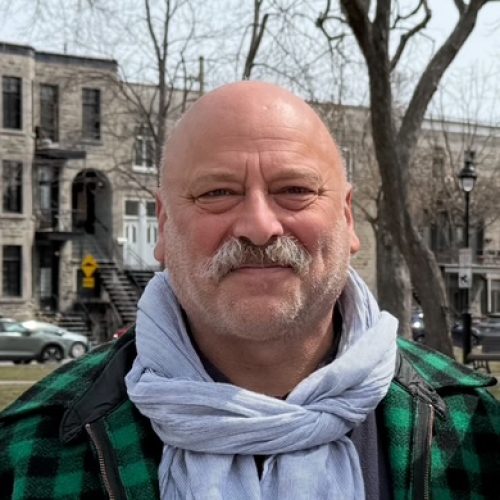
Albert Sebe will never forget the moment doctors told him he had 12 hours to live. It was the summer of 2020, and his father had driven him to the Jewish General Hospital from his country place. Albert was too weak to drive himself: he was barely able to stand and his vision was fading into tunnel vision.
“It was as if we were driving through a snowstorm,” he says.
When they arrived, the medical team acted immediately. “In 15 minutes we’re operating on you,” they told him. “You’re a really sick man. Had you not been here in 12 hours, you were a dead man.”
What followed was a grueling two and a half months in the hospital, alone in isolation during the height of the COVID-19 pandemic. Albert had colorectal cancer, but his case was extraordinarily rare. One in a billion, the doctors said. The infection from a fistula had spread to his urinary system. It caused complications that would require multiple surgeries and a panel of five doctors to determine the best course of treatment.
Alone in the Storm
During those long months in the hospital, Albert couldn’t have visitors. He spent his days in a small room, connected to machines, with only a view of north Montreal to keep him company. The isolation was crushing.
But the challenges didn’t end when he left the hospital. Albert faced radiation therapy appointments every few days, followed by chemotherapy sessions. He was weak, unable to drive, and his immune system was compromised. Taking the metro during a pandemic was out of the question.
Then there was the financial blow. Because Albert was honest about being too sick to work, his unemployment insurance was cut off after 15 weeks instead of the 55 weeks he had been promised. “If I had lied and said I was fine and healthy, I would have had my 55 weeks,” Albert explains. “But because I was honest, they cut me off, and I had nothing.”
A Lifeline When It Mattered Most
That’s when Hope & Cope stepped in. Referred by oncology nurse Natalie Leone to Sandy Lipkus, Albert was connected with the organization’s transportation services. A driver would pick him up and bring him to every radiation and chemotherapy appointment.
“That just took a lot of stress off,” Albert says. “I don’t know how I would have gone to the hospital otherwise. My brother was working. My dad was 84, and the stress of me being sick was already a lot. This was the best way of dealing with it.”
Hope & Cope also connected Albert with social worker Brahms E. Silver, who provided emotional support during the darkest moments. Albert remembers one conversation in particular, shortly after actor Chadwick Boseman died from colorectal cancer at a young age. Albert was terrified.
“Brahms asked me ‘Well, did they have that conversation that there’s nothing we can do?’ And I said no, they didn’t,” Albert recalls. “He replied, ‘Well, that’s a start.’ And I’ll never forget that.”
Those words became a turning point. They reminded Albert that despite everything, there was still hope. There was still a future.
Five Years Later: Giving Back
Today, Albert is five years cancer-free. He lives with a colostomy and urostomy, the result of his complex surgeries. But he doesn’t let that stop him. He teaches army cadets on Fridays, creates artwork, and plants garlic for next year’s harvest.
“I get walked by my 10 pound physiotherapist, personal trainer, and therapist,” , he says with a laugh. “Doesn’t cost much but a cup of food per day!”

And he volunteers with Hope & Cope as a peer supporter. When someone is facing a similar diagnosis or surgery, Albert is there to talk them through it, sharing his experience and offering the same kind of support he once received.
“I’m giving back what I got myself,” Albert says. “If you can take something bad that happened in your life and make it into a positive and share it with others, then that’s a good thing.”
He’s spoken at a conference for ostomy care nurses, sharing his story and the powerful words Brahms E. Silver once told him. Nurses have told him they’ll keep those words in their hearts for their own patients.
A Message of Hope
When Albert talks to newly diagnosed people with cancer who are hesitant about reaching out to Hope & Cope, his advice is straightforward: “Don’t be afraid. Try it. You’ll see that they’ll help you. They’ll try to bend backwards to help in any which way that they can.”
His philosophy now centers on one core belief: never stop looking to the future. Even when he was desperately ill in the hospital, Albert taught his army cadet classes via Zoom, determined to keep moving forward. The kids didn’t even know he was sick until two years later.
“I don’t let it stop me,” Albert says. “I’m always looking for the future. Today’s today, which is a great day, and tomorrow is another day. If I wake up and it’s tomorrow, that’s another great day. Just keep on looking for the future.”
Inspired by this story? Hope & Cope volunteers make a real difference in the lives of people with cancer and their families.
Whether you have a few hours a week or want to support our mission through a donation, there are many ways to get involved.
To become a Hope & Cope volunteer:
Visit hopeandcope.ca/volunteer-application-form-2.To support Hope & Cope with a donation:
Visit hopeandcope.ca/donate.


