

We are not humans having spiritual experiences; we are spirits having human experiences.
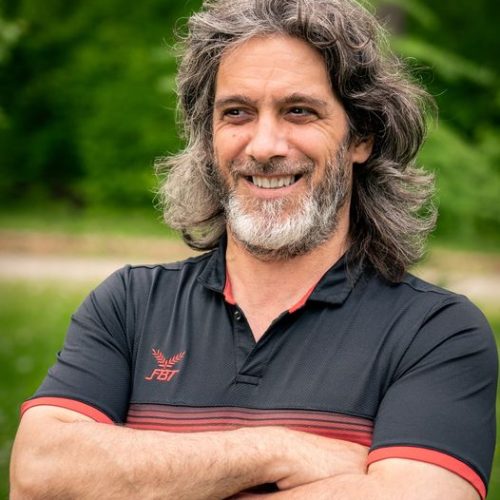
My name is Marc-André Germain. Since 2022, I have been volunteering with Hope & Cope in the Palliative Care Unit at the Jewish General Hospital in Montreal. I also participate in Mourning Cafe, where I accompany people who are grieving.
It may come as a surprise to learn that I spend my Friday evenings and Saturday afternoons in palliative care. Yet it was a natural path for me. I studied English literature, and death, that great mystery, has always been a theme that fascinated me.
I taught in Asia and have lived half my life abroad. But it was the death of my father, in the same palliative care unit where I work today, that really crystallized everything for me. I saw an imperfect healthcare system, but I also saw dedicated nurses and volunteers. And I said to myself: it’s easy to complain (it’s the national sport), but I wanted to take action.
The yoga of service
I am a yoga and qi gong instructor. In yoga, there is a branch called karma yoga: the yoga of service. The idea is to give without expecting anything in return, to free yourself from expectations.
When I go to my regular job, I expect to receive my salary. But when I go to palliative care and give to people who will no longer be here in two weeks or two months, I can’t receive anything in return. And having no expectations is liberating. It gives me more rewards than any paycheque.
“My mission is to come and see if you need company in some way. Whatever the answer, the mission is accomplished.”
My mission is to come and see if someone needs company in some way, whether it’s a blanket, whether it’s to talk about their life, whether it’s to laugh a little, a moment of shared silence.
I don’t expect to be told a story; I don’t expect a spiritual transformation. I expect absolutely nothing. There is no reward, there is no obligation. It’s spontaneous, depending on the need, and I think that’s the beauty of it.
Seeing beyond the diagnosis
I am legally blind. My white cane is often an icebreaker in palliative care. My loss of sight gives me a small glimpse into what patients experience: the loss of independence.
When you lose your sight, it’s a complete redefinition of your identity. It’s the same with cancer. People need to be reminded that they are more than their diagnosis. If you have pancreatic cancer, you are still you; you don’t become pancreatic cancer.
I have a mantra that helps me: “I am not special.” Because if I am special, then it becomes “why me?” and “why not others?” What happens to me happens to others too.
I also believe that there is an important normalization in the relationship I have with patients. When they talk to a doctor, nurse, or attendant, there is a certain hierarchy. But not with me, and that helps build relationships.
A place where people no longer wait to live
When I talk to people about my volunteer work, they imagine that palliative care is a place where people spend their time moping and trembling with fear. That’s not what I see at all.
It’s not a place where people wait to die. It’s a place where people no longer wait to live.
Death is a taboo subject. Some people think that simply writing a will is signing their death warrant. But it’s a gift to those who survive: it takes away the mental burden and uncertainty.
Some people think they have to be with their loved ones 24 hours a day. But about 50% of people want to die alone. So yes, you can go get a coffee and come back. Your loved one can hear you. They may just be waiting for you to leave the room to take their last breath.
The lessons I learn
I said earlier that I get nothing in return, but in truth, I am rewarded with incredible life lessons.
Like the patient who told me he had been very materialistic and had not lived an exemplary spiritual life. But when faced with death, he began to ask himself questions. He said to me, “I have no idea what kind of world there is, but I’m going to move on to another existence. And I’ll say two things about the world I’m leaving behind: one, that it’s full of beauty, miracles, and wonders. And two, that it’s populated by people who don’t realize it.”
I’m also continuing my training as an end-of-life doula. It’s similar to what birth doulas do, but for the transition to death. My role is to provide non-medical care: preparing people, demystifying the process, guiding them in their choices. Sometimes it’s as simple as saying to someone, “You know you have the right to hug your spouse on the bed, right?” So many people think that once their loved one is bedridden, they can no longer touch them.
What I want is for us to normalize conversations about death. That we can talk about it before we’re in crisis. Because I’m convinced that if we had these conversations in advance, there would be fewer regrets, less anxiety, less uncertainty. And perhaps more moments of real life.
Even—and especially—as death approaches.
Inspired by this story? Hope & Cope volunteers make a real difference in the lives of people with cancer and their families.
Whether you have a few hours a week or want to support our mission through a donation, there are many ways to get involved.
To become a Hope & Cope volunteer:
Visit hopeandcope.ca/volunteer-application-form-2.
To support Hope & Cope with a donation:
Visit hopeandcope.ca/donate.


