

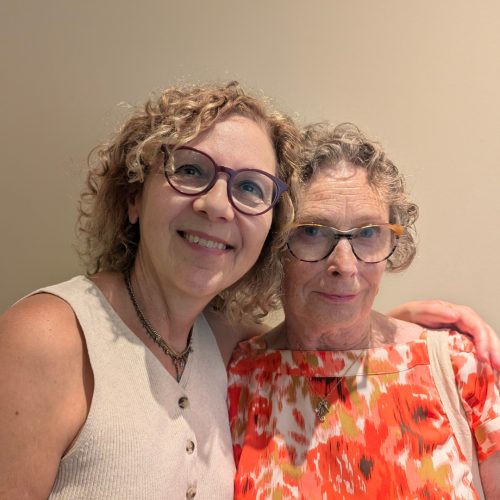
For members of the Voices of Hope choir, Mondays are all about music.
“They’re not here because they’re sick,” says Deborah Kraus, the choir’s co-director. “They’re here because they want to make music. Our choristers sometimes arrive in the middle of treatments, tired. But after we spend the hour and a half together they’re completely energized.”
The weekly rehearsal is the highlight of their week for many. Michèle Hekimi, who co-leads the choir and is one of the original founders, puts it simply: “Music makes people happy. If you can talk, you can sing. Just the vibration, the movement of the voice, and the sound around us make us feel better and more energetic.”
The choir was founded in 2008, and it was based on a simple belief: music has the power to heal.
One of its core values is accessibility: no musical experience is required. “You don’t need to know music or how to read notes, because you can learn by ear,” says Michèle. She and Deborah make it as easy as possible for the choristers.
Deborah records each part so members can practise at home. The choristers learn their parts by ear and tackle music in different languages and styles. From jazz to classical, the choir has performed in English, French, Italian, and Spanish. It has allowed people who might never have thought of themselves as singers to discover their voices and grow in confidence.
Singing and Its Numerous Benefits
The benefits of singing go far beyond the stage. It is a deeply physical and cognitive activity. It demands breathing, stamina, and concentration. It helps keep the mind stimulated, especially for those whose memories are affected by medication.
Choristers use their bodies as instruments, which helps release inhibitions. Music taps into deep emotional and even spiritual connections. “It just feels right when you sing,” says Michèle. “It’s a connection to the soul. Our souls are aching for so many reasons. So making music together is a balm. And I think it should be compulsory in all schools.”
Deborah agrees: “The texts are meaningful and allow everyone to tap into different emotions and be supportive of each other. And we laugh a lot. They leave—I leave—greatly energized.”
Performing with Pride
Every year, the choir prepares at least two concerts. For many, these performances are transformative moments.
“They don’t have that experience of singing in front of others, and suddenly they’re the star of the evening,” Michèle says. Families attend, seeing their loved ones not as patients but as performers, filled with pride and joy.
“It makes them so proud and so happy,” says Deborah. “It’s another level of accomplishment.”
Even during the COVID-19 pandemic, the choir found ways to keep singing together. “We met every week on Zoom,” Michèle explains. “Even if it wasn’t perfect, we were able to make music, and it was a very special connection.” For some who lived alone, those virtual sessions were a lifeline.
A Community of Care
Beyond the music, the choir is a place of friendship and support. Members look out for one another, checking in if someone is absent.
“They really have formed quite a friendship amongst them,” says Deborah. For one singer who moved to Montreal without family nearby, the choir became more than a hobby: it became her family. “She has sung some beautiful solos at our concerts, and it’s been very emotional for her to have found a family that she can be part of.”
This sense of belonging is especially important because the choir welcomes members indefinitely. As Michèle explains, “You can’t say to someone after after two years, ‘You cannot come to the choir anymore.’ It takes time to learn and to grow your voice.”
This spirit of openness allows members not only to stay, but also to discover new sides of themselves.
For Michèle, that means encouraging choristers to reclaim something many of us lose in adulthood. “We are raised not to use our voice, not to speak loudly,” she says. “And suddenly, in rehearsal, I ask them to scream and to shout. Just that, my God, it can change your day!”
Deborah sees the same transformation each week.
“Many of our members have never sung before, they don’t read music, and yet they find the courage to sing in harmony,” she says. “It’s wonderful to see them realize they can do it.”
Interested in joining the Voices of Hope choir? No musical experience is necessary—just a love of music. Rehearsals take place on Mondays from 2:30 to 4:00 p.m. at the Hope & Cope Wellness Centre. To register, call the Wellness Centre at 514-340-3616.


