

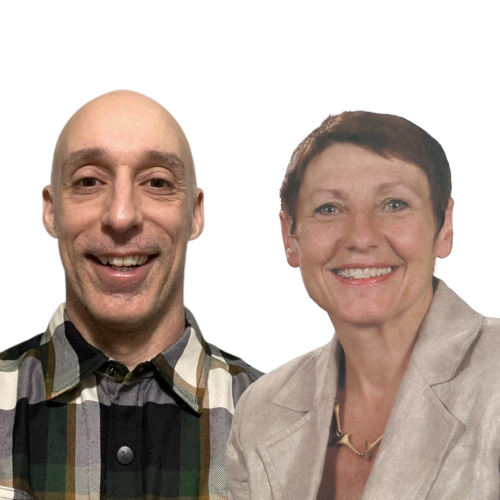
When Diane Morissette discovered reiki in 2011, she knew that one day she would want to share it with people going through difficult times. When Dominic Audet, a Reiki master since 2015, looked for a place to offer his services, he knocked on many doors before finding the right one.
Today, Dominic leads weekly Reiki sessions at Hope & Cope, and Diane supports him by channeling the energy as well. Their paths, though different, led them to the same destination.
Diane began practicing reiki on herself, then on her loved ones, before deciding to volunteer. A conversation with a volunteer at Hope & Cope was all it took. In 2015, she offered her first sessions at the Wellness Centre, where she saw two people a day.
Dominic, for his part, was looking for a place to share the benefits he knew so well. He knocked on hospital doors, was turned down, until one day someone told him about Hope & Cope. In 2019, he began volunteering. A few months later, the pandemic changed everything.
Rather than canceling the sessions, they adapted. The meetings went virtual, and something unexpected happened: they reached more people than ever before.
Although the number of participants has grown, a question remains in the minds of those who have never experienced it.
What exactly is reiki?
That’s the big question, the one Dominic has been mulling over for years.
“It’s always hard to find the right words to describe it,” he admits. “The term comes from Japanese and roughly translates to ‘universal life force.’ The short answer: it’s an energy healing practice (reiki) for a person’s well-being by laying hands on them.”
But the question remains: what exactly is REIKI?
“As a practitioner and teacher, I’d say it’s not a simple ‘black or white’ question. This question always leads to other questions. It’s more like a process that guides a person through stages and levels that everyone experiences at their own pace. Depending on a person’s level, reiki is explained differently because it’s something that must first be experienced, rather than intellectualized. »
For a more in-depth exploration of Reiki, read this (French) document written by Dominic.
The basic principle of Reiki: everything is energy. When this energy flows poorly, imbalances arise—whether physical, emotional, mental, or spiritual. Reiki works to restore this flow and regain a sense of balance and well-being.
Diane offers a more concrete image. “You don’t need to believe in it, just feel it. It’s like stepping into a lake. The currents are very real, even if you can’t put a name to the sensations they create.”
Reiki has been around for over a hundred years. Studies in hospital settings began in the late 1980s. It’s not new, even if many are hearing about it for the first time.
What Participants Experience
During a session, participants don’t have to do anything. They simply put themselves in a receptive state. The sensations vary from person to person: intense heat, tingling, a feeling of lightness, and sometimes tears for no apparent reason. Some people fall asleep. This is allowed, and even encouraged.
What strikes Diane and Dominic is the evolution over time. People who have been participating for several years reach a state of deep receptivity almost immediately. “You can see the difference in their faces from one week to the next,” observes Dominic.
And when participants miss a week, they feel it.
“I missed my reiki from last week,” they say upon their return.
One of the testimonials that touched them most was from a participant nearing the end of her life who confided, “Thanks to the sessions, you’ve given me back my will to live.” She knew she was going to die. But she lived out her final months with a newfound serenity, like a flower blooming.
Not everyone will experience exactly the same thing, but it’s undeniable that something real happens during a reiki session.
When Science and Tradition Meet
Since 2020, McGill medical and nursing students have been participating in the sessions alongside people with cancer. For Diane, this is the aspect that continues to inspire her the most.
“There’s a kind of collaboration between the scientific side and traditional approaches at Hope & Cope,” she says. “You don’t see that everywhere.”
One nursing intern even asked if she could continue participating in the sessions after her internship ended, because she enjoyed them so much.
For Men, Too
For years, Dominic has observed that more than 95% of participants are women. Men are hesitant. Not because they lack interest, but often because they’ve been taught that showing vulnerability is a sign of weakness.
“That’s not true,” Dominic says simply. “Reiki isn’t gendered. ”
Diane agrees. That’s why she was thrilled when Dominic volunteered. His presence alone demonstrates that these practices are universal.
The weekly sessions are free and open to anyone living with cancer, as well as to caregivers. No commitment is required. No need to believe. Just be willing to try.
“Come, be open, and experience it for yourself,” says Dominic. “Reiki is for you, no one else. Take a moment for yourself. Forget all the explanations. Just come and experience it.”
Dominic and Diane’s reiki sessions are offered free of charge every week online to anyone affected by cancer and to caregivers. To register or learn more, contact the Wellness Centre at 514-340-3616 or welnesscentre@hopeandcope.ca.
Would you like to make a difference in the lives of people affected by cancer? Hope & Cope is always looking for dedicated volunteers. Contact us at mailto:volunteering@hopeandcope.ca to learn more, or fill out the application form.


