


Without Sheila Kussner, would cancer still be a taboo topic of discussion? Fortunately, we’ll never know.
Sheila Kussner, z”l, O.C., O.Q., C.O.M. was known for the creation of Hope & Cope, her unwavering drive to improve care for cancer survivors, and, of course, her unparalleled ability to raise funds.
She had accomplished much before her death on August 6, 2024:
- She founded Hope & Cope in 1981 and pioneered peer-based cancer support in hospital settings
- Hope & Cope established Canada’s first Young Adult Patients’ support group
- She opened the Hope & Cope Wellness Centre in 2007, Montreal’s first hospital-affiliated cancer wellness facility
- She raised an estimated $100 million throughout her lifetime for cancer care and medical research
- She spearheaded the creation of McGill University’s Department of Oncology, raising $30 million
- She helped establish the Christine and Herschel Victor – Hope & Cope Chair in Psychosocial Oncology, Quebec’s first research chair of its kind
As a result she received many honours:
- Officer of the Order of Canada
- Officer of the Order of Quebec
- Commander of the Order of Montreal
- Honorary doctorates from McGill University and Université de Montréal
- Robert Fisher Fellowship Award from Memorial Sloan-Kettering Cancer Center
- Queen’s Diamond Jubilee Medal
- Eleanor Roosevelt Humanitarian Award in recognition of her significant humanitarian work
And that only scratches the surface.
While those accomplishments are remarkable for any person, it’s what happened behind closed doors that truly defined Sheila. The late-night phone calls to check on friends travelling. The handwritten notes on expensive stationery. The meals and sweets she baked when she sensed someone needed a lift.

On the first anniversary of her passing, we sat down with her long-time friend, Suzanne O’Brien, former executive director of Hope & Cope, to discuss the life and legacy of Sheila. The part that very few people knew. The part that touched many people profoundly.
The To-Do Lists
“During COVID, we had many long conversations about the future,” Suzanne explains. “Sheila knew she was aging. She knew she wasn’t well, and she knew there were a lot of things she wanted to do. So she had to-do lists.”
Sheila would share her lists with Suzanne, crossing items off, adding new ones. “Just the week before she died, she said that whenever her time came, I had to finish the lists!”
The lists were not the type of “bucket list items” where you try to do the most you can for yourself. They were all about helping others.
“Right up until the day she died, she was still trying to get doctors’ appointments for people who didn’t have one,” Suzanne says. “She was still trying to find a job for somebody who was out of work.”
Purposeful Acts of Kindness
Sheila approached helping others with the same methodical intensity she brought to her fundraising campaigns.
“Her acts of kindness were very purposeful,” Suzanne says. “It was not a one-size-fits-all response to people. She thought, ‘What would make this special for a patient, a volunteer, a donor or a friend?’ Sometimes it was sharing a book, sometimes it was writing them a poem that made them laugh. She wrote things that were unique to that person and people loved her for it.”
Even with flowers—and Sheila received many—there was intention. “Sometimes she’d say, on her birthday, that her house kind of looked like a funeral parlour with so many flowers. But she would give them to people very purposely. She just said, ‘You know, this person could use some cheering up. It might be just what they need.’”
Sheila would go through extraordinary lengths just to add a little brightness to someone’s day. “I remember days when she wasn’t feeling well herself but insisted on visiting a friend or a patient in hospital to spend time with them and give them encouragement before upcoming treatment or because they were feeling down,” says Suzanne. “We would go in the evening so that she wouldn’t be stopped by too many people recognizing her as I wheeled her around in her wheelchair to their rooms. The whole effort to get her there was disproportionate to the time spent—sometimes only five minutes—but the time spent was just magical for that person.”
It made a huge difference and that was all that mattered to Sheila.
Beyond Hope & Cope’s official programs, Sheila operated what Suzanne calls “her own compassionate fund.” The unofficial “Sheila Kussner Compassionate Fund,” if you will.
“I think what people don’t know is how many times she used her own money to get help for people who didn’t have it,” explains Suzanne. “She just thought the system favoured you if you’re well off. Ill health is an equalizer, but access to resources is not equal. So she absolutely went above and beyond to try and give access to resources to people who didn’t have them”
The Treasure Trove of Drafts
When Suzanne and Sheila’s family cleaned out her home, they discovered something that would surprise many who knew her as a natural speaker and fundraiser.

“We found boxes and boxes of drafts of letters and speeches that she’s given,” says Suzanne. “They contained passages that were underlined and paraphrased and indications of where to put emphasis: say this slowly, say this clearly. Despite the number of speeches she gave in her life, she was not a natural speaker. Sometimes the emphasis was different in different copies because obviously she would practise that and say, ‘No, no, the emphasis should be somewhere else.’”
The cleanup also revealed the extent to which Sheila treasured connections with others. “We found lots of notes that people had written to her that she had treasured and kept aside. And given the thousands of letters that came into her house, she kept an awful lot of them.”
That connection goes both ways, as many people kept the notes that Sheila wrote over the years. One donor, Sal Guerrera, is such an example. “He’s kept every single note she’s ever written to him, and he’s putting them into a book.” According to Suzanne, many others have said the same: “They say, ’I’ve got so many notes from Sheila, and I prize them.’”
These weren’t casual thank-you notes nor were they electronic cards that have become the norm. Sheila’s notes were handwritten. “They’re full of hope,” explains Suzanne. “She would write a beautiful condolence note when someone lost a person dear to them. And on the anniversary of that loss, many have told me that they’ll pull out Sheila’s note and read it because it was just so compassionate. It’s ongoing healing for some people.”
Finding Joy in the Joy of Others and Going the Extra Mile
Sheila found genuine happiness in the happiness of others.
“I think people know how much she did, but I don’t think they realize how much joy she found in doing it,” Suzanne says. “She found joy in other people’s joy: at their birthdays, weddings, or birth of a child. If she read something about them in the newspaper, she had to pick up the phone and congratulate them or write them a little note.”
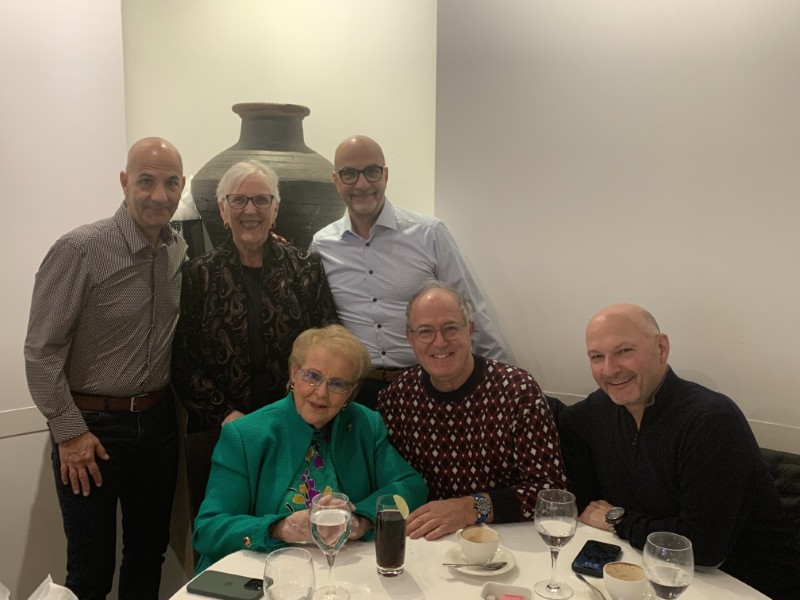
But Sheila also carried the weight of others’ pain. “She also experienced distress in their distress. And that was a burden she took on herself. She really felt for other people in their grief, in their sickness, because she knew grief and she knew sickness.”
Suzanne often returns to what she calls Sheila’s life mantra: Go the extra mile.
“She always thought that there was something wrong with our system when we didn’t go the extra mile. And she didn’t think that was extraordinary. She just thought that was what one human being should do for another.”
This philosophy extended to her vision for Hope & Cope’s future. “She was curious about the future,” concludes Suzanne.”She really thought Hope & Cope had made a difference in her life by always going the extra mile. Sheila told me, ’It’s a pity I won’t be around to see how it turns out many years from now, but I hope they always remember that ill health has no time clock. Just always go the extra mile because you don’t know what’s in someone’s life and how a moment of empathy and compassion can make such an enormous difference.’ It is a value she lived by and a value she has bequeathed to us.”
If you would like to celebrate Sheila’s legacy and contribute to Hope & Cope’s continuing work, consider attending the upcoming Butterflies and Bubbles fundraising event. Details can be found on the event page.


